
Straight answers
Floor coating questions from Spring Valley
What it costs per foot, which system fits, how the heat and sun treat a floor, and what happens on install day. Answers come from the slabs we grind across Spring Valley and the Las Vegas valley.




Reading a quote
What moves the number on a written estimate
Two written estimates for the same garage can look nothing alike. These five lines explain most of the gap.
- PrepGrinding bare concrete is quick. Grinding off a peeling kit, sealer or soaked-in oil takes longer and should be its own line.
- MoistureA slab that tests damp needs a moisture-blocking primer or drying time. Ask whether a test was run and what it read.
- CracksStatic cracks get routed and filled before coating. Moving joints are left to move. Count the cracks listed against the ones you see.
- Square footageRates are per square foot, so check the measured area. Steps, a storage nook or a side bay all add to it.
- SystemFlake epoxy, a polyaspartic top or full polyurea are different materials and labor. The estimate should name the coats, not just the color.
01
Cost and estimates
We price by the square foot, so a 20x20 is quoted from its measured area. A flake epoxy system in the Las Vegas valley typically runs about $4 to $7 per square foot. Where yours lands depends on slab condition, crack repair and how much old coating has to come off. You get that number in writing after we see the floor.
Yes, usually. Polyaspartic and polyurea systems typically run about $6 to $12 per square foot here, against about $4 to $7 for flake epoxy. You are paying for faster cure and a UV-stable top. Plenty of garages do well with an epoxy base under a polyaspartic topcoat, and we will price both if you ask.
Because the slab sets the price, not the brochure. Oil soaked into the concrete, a peeling DIY kit, a crack that runs wall to wall, a damp test result: each one adds grinding, filling or a different primer. A phone quote would have to guess at all of that. We would rather measure it and write it down.
Almost always. New material bonds only as well as the layer under it, and a failing coating will keep failing with ours on top. We grind it off down to clean, sound concrete. On a garage with a thin, worn kit that goes quickly. A thick, well-stuck coating takes longer, and the estimate says so up front.
Case by case. Those jobs vary too much in size, prep and finish for a fair per-foot range, so we do not publish one. We look at the surface, talk through the look you want and hand you a written estimate that spells out the prep, the system and the area it covers.
02
Choosing a system
They do different jobs, and many good floors use both. Epoxy builds thickness and grips the slab. A polyaspartic top resists sun and scuffing and cures fast. Where the door stays open to afternoon sun, that UV-stable top matters most. A shaded, closed garage can do fine with a heavier epoxy build and a urethane cap.
Close relatives. Polyaspartic is a slower-setting type of polyurea, which gives an installer time to roll it by hand. Straight polyurea can set in minutes and is usually sprayed. What decides yellowing is aliphatic versus aromatic chemistry, not the name on the pail, so ask which one is going on your floor.
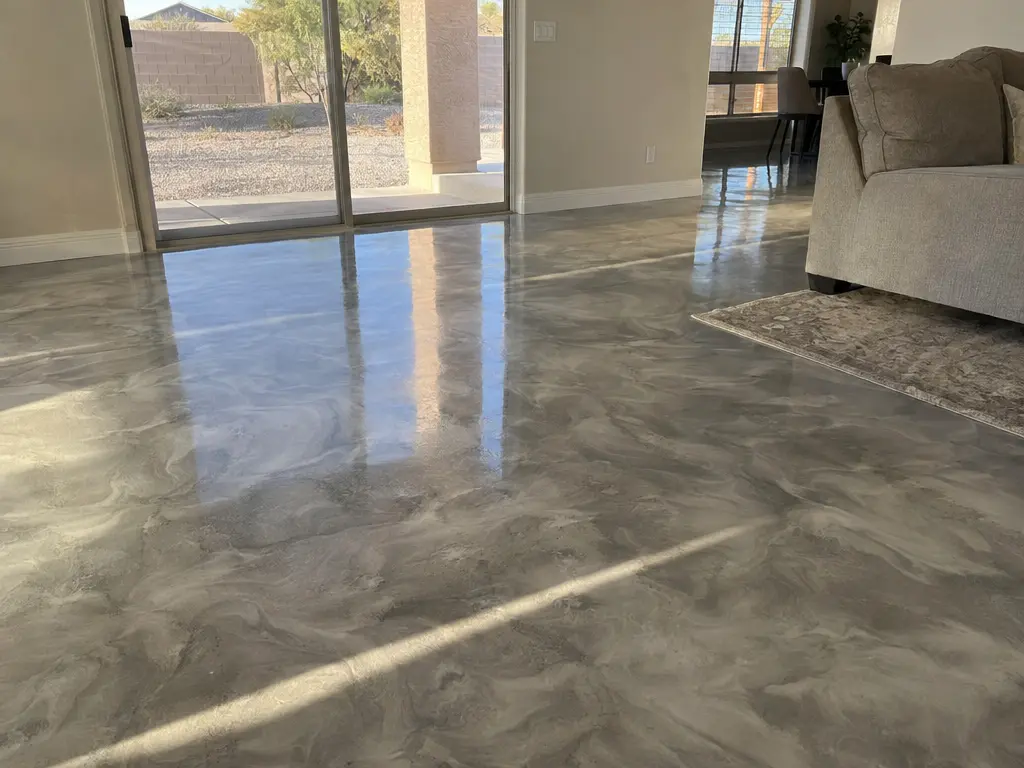
It is clear epoxy carrying metallic pigment, poured over a colored primer and worked while wet so it flows into a marbled, three-dimensional pattern. No two floors match. It suits living areas, shops and showrooms, indoors only. It also shows every grind mark underneath, so the prep has to be cleaner than for a flake floor.
Smooth and glossy, so it can be slick with water or dust on it. That is why we finish metallic floors with a clear topcoat and can add a fine grit to it where people walk in wet or in socks. In a garage we usually steer people toward flake, which has texture built in.
Often, if the slab is sound and hard enough to take a polish. Polishing grinds the concrete itself with finer and finer diamonds and hardens it with a densifier, so there is no coating to wear through. It tested above the wet-slip threshold in industry testing even at high gloss. A soft or patched slab is better coated.
Yes, if it is clean, bare and open enough to take color. Acid stain reacts with the slab and gives mottled earth tones that differ floor to floor. Water-based stain gives wider, more even color. Either one needs a sealer over it. Old paint, sealer or glue has to come off before any stain will take.
03
Heat and the Las Vegas climate
Tires come in off summer asphalt soft and hot. They press into the coating, then grip it as everything cools, and a weak floor lifts with them. Thin films, poor grinding and parking too early make it worse. A ground slab, a high-solids base and a hard polyaspartic wear layer are what stop it.
Standard epoxy can. Its chemistry ambers under UV, and summer UV in Las Vegas reaches the extreme range. A garage that faces west with the door up all afternoon gets plenty. An aliphatic polyaspartic or urethane topcoat holds its color. A clear top slows the epoxy under it from yellowing but does not stop it fully.
Usually, yes. SNWA rates valley water at about 16 grains per gallon, and the minerals stay behind wherever water dries on a surface. Hose drips, car washing and sprinkler drift all leave chalky spots. On a sealed floor they wipe off with a damp mop and a dry pass. Flake and lighter colors hide them better than dark gloss.
Slowly, if nobody sweeps. The National Weather Service notes that strong winds here bring blowing dust and sand, most often in spring and fall. That grit acts like sandpaper under tires and shoes. The topcoat is the wear layer, so a regular sweep or dust mop keeps it doing its job longer.
04
Pool decks and outdoor concrete
Yes. Cool deck is a thin acrylic-cement texture sprayed and knocked down over the slab you already have. The concrete has to be clean, sound and roughened first, with loose or hollow areas dealt with. A deck that is cracked through or lifting needs that repair before any new surface goes on.
Standard epoxy is a poor fit outdoors for two reasons. It yellows in sun, and it does not breathe, so moisture rising through the slab can blister it loose. Outdoors we look at aliphatic polyaspartic, a textured acrylic-cement finish or a penetrating sealer, depending on the surface and how it gets used.
Color and texture, mostly. Most people who have crossed a dark, smooth slab in a Las Vegas July know how hot it gets. That is why light, textured finishes are the common choice around pools here. We do not quote surface temperatures; we help you pick a light color and a texture that grips wet feet.
No. We work on the deck surface only. Pumps, heaters, lighting, plumbing and anything electrical belong to those trades, and we leave them alone. If you have equipment work planned, it makes sense to finish it before the deck is resurfaced so nobody cuts into new work.
05
Process and scheduling
Often the same day, a few hours after the last coat, though heat and humidity move that clock. Cure is driven by temperature, not by a timer. Full chemical cure takes longer, commonly about a week, so we tell you when to walk, when to park and when to put heavy shelving back.
Yes, before any coating goes down. Moisture rising through a slab is a top cause of coatings lifting. A calcium chloride dome reads the surface, and an in-slab probe reads deeper. If the result is high, we use a moisture-blocking primer or let the slab dry, and the estimate tells you which.
We grind with shrouded diamond grinders hooked to dust-collecting vacuums, so the dust is pulled in at the head instead of drifting through the garage. Nothing from the job gets washed into the street or a storm drain. Close the door into the house anyway, because some fine dust always finds a way.
Everything on the floor: cars, bikes, storage bins, shelving and anything leaning on the walls. Wall-mounted cabinets can stay if they clear the floor. Take down anything hanging low over the slab. If the water heater or other fixed equipment sits on the floor, tell us at the estimate so we plan around it.
Call or send the form with your address and a line about the floor. We set a time to come out, Monday through Saturday, 7am to 6pm. We look at the slab, ask what you want from it and leave you a written estimate. Rhodes Ranch, Spanish Trail and the rest of Spring Valley are all on our route.