
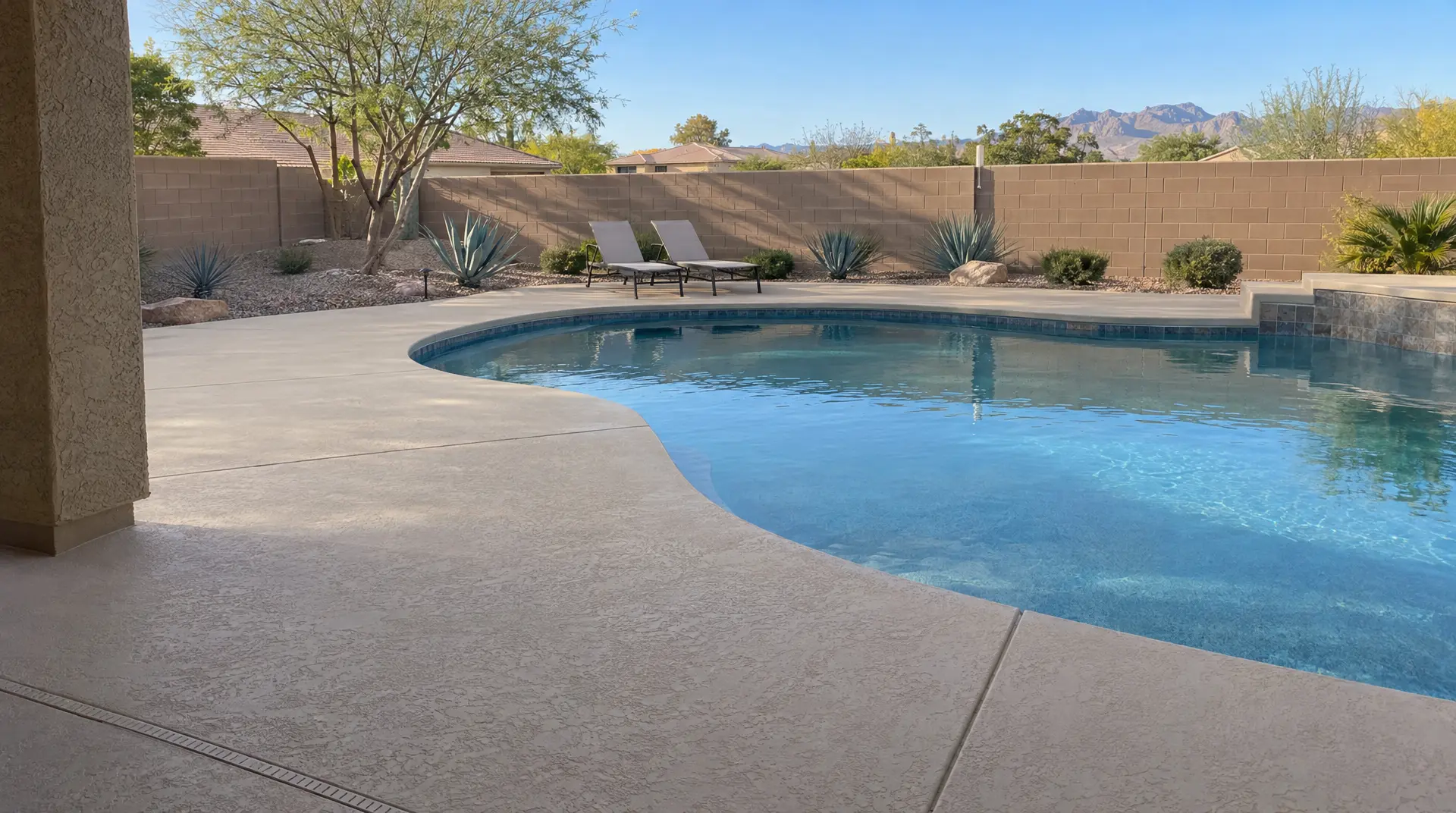
A pool deck in Spring Valley, or anywhere in the Las Vegas valley, takes more punishment than almost any other concrete around a house. Bare feet, splash water, chlorine, sun and summer heat, all on the same slab. Here is how cool deck compares with the other ways to surface it.
Why pool decks are their own problem here
There are about 200,000 residential pools in the Las Vegas area, so this is not a niche question. From Rhodes Ranch to the newer tracts off the 215, those decks are concrete, and most of them get the full desert treatment.
July's normal high at the airport station is about 104.5F. Summer UV reaches the extreme range. And the people walking on the deck are usually barefoot and wet, which is the hardest test any floor gets: it has to be comfortable, grippy and easy to keep clean, all at once.
A garage coating chosen for gloss and stain resistance is the wrong tool for that job.
What cool deck actually is
Cool deck is a thin acrylic-cement finish, sprayed over existing concrete and then knocked down with a trowel to leave a flattened, splattered texture. It usually goes on in a light color.
It is a surface layer, not new concrete. That means the slab under it matters. It has to be clean, sound and roughened so the finish can bond, and loose, hollow or lifting areas have to be dealt with first. A cool deck sprayed over a failing slab will fail along with it.
Heat underfoot: color and texture do the work
Anyone who has crossed a dark, smooth slab in a Las Vegas July knows how hot it gets. That common experience is why light, textured finishes are the usual choice around pools here.
We will not quote you surface temperatures, and you should be careful with anyone who does. Independent measurements of deck finishes are hard to find, and the cooling claims we have seen come from the people who sell the product. What holds up without a lab: lighter colors stay more comfortable than dark ones, and a textured surface feels different from a slick one.
So when you choose, start with color. Then pick the texture.
Texture and slip on a wet deck
Wet bare feet on a smooth surface is how people fall.
Slip resistance on coated floors is engineered, either by broadcasting an aggregate into the coating or by building texture into the finish itself. The industry standard for measuring it is a wet dynamic coefficient of friction, and outdoor and wet areas are expected to test higher than a dry interior floor.
Cool deck brings its texture with it. That knockdown pattern is the grip. Smooth coatings can be made safer with a broadcast grit in the topcoat, but they start from a slicker place.
The tradeoff is cleaning. More texture means more places for dirt and mineral spots to settle. Most owners decide that is a fair trade next to a pool.
Other pool deck coatings worth knowing
Aliphatic polyaspartic. UV-stable and flexible, which suits an outdoor slab that moves with the heat. With a broadcast for grip, it can work on decks and patios.
Stain and sealer. Acid or water-based stain colors the concrete itself, then a UV-stable sealer protects it. It keeps the slab's own texture. Sealers wear and need recoating every few years.
Thin decorative overlay. A polymer-modified cement layer, built up in very thin lifts, that gives the deck a fresh surface to color or texture. It can be sprayed, troweled or stamped. Like cool deck, it needs a clean, sound, moisture-checked slab, plus a bond coat so old grind marks do not show through the new layer.
Penetrating sealer. Soaks in, leaves no film, keeps the slab breathable. It protects without changing the look much.
Standard epoxy. The one to avoid outdoors. It yellows in sun, and because it does not breathe, moisture rising through the slab can blister it loose. One more trap: some polyurea is aromatic and yellows too, so ask which kind is going down.
Living with hard water on a pool deck
The Southern Nevada Water Authority rates valley water at about 280 parts per million, or 16 grains per gallon, which it calls very hard. The minerals come from the Colorado River by way of Lake Mead.
SNWA also explains the part that matters for a deck: mineral residue is left only where water evaporates. Splash-out, sprinkler drift and hose rinses all dry fast in the sun, and each one leaves a little calcium behind. Over a season that shows up as chalky white spotting.
Light, textured finishes hide it better than dark, smooth ones. A regular gentle clean keeps it from building up.
Resurface or recoat?
If the deck is sound and the finish is just worn, faded or stained, a recoat is often enough. The surface gets cleaned and prepped, and a fresh top layer goes on over what is there.
Resurfacing is the bigger job. It makes sense when the old finish is peeling or sounds hollow, when cracks have opened up, or when patches from past repairs no longer match. Loose material comes off, cracks are filled, and a new overlay or texture goes down over sound concrete.
Either way, the estimate should say which one you are getting and why. One note on scope. Deck work covers the deck surface only; pumps, lights, heaters and plumbing are separate trades.
If your deck is due for one or the other, here is how we handle pool deck resurfacing and cool deck in the valley.