
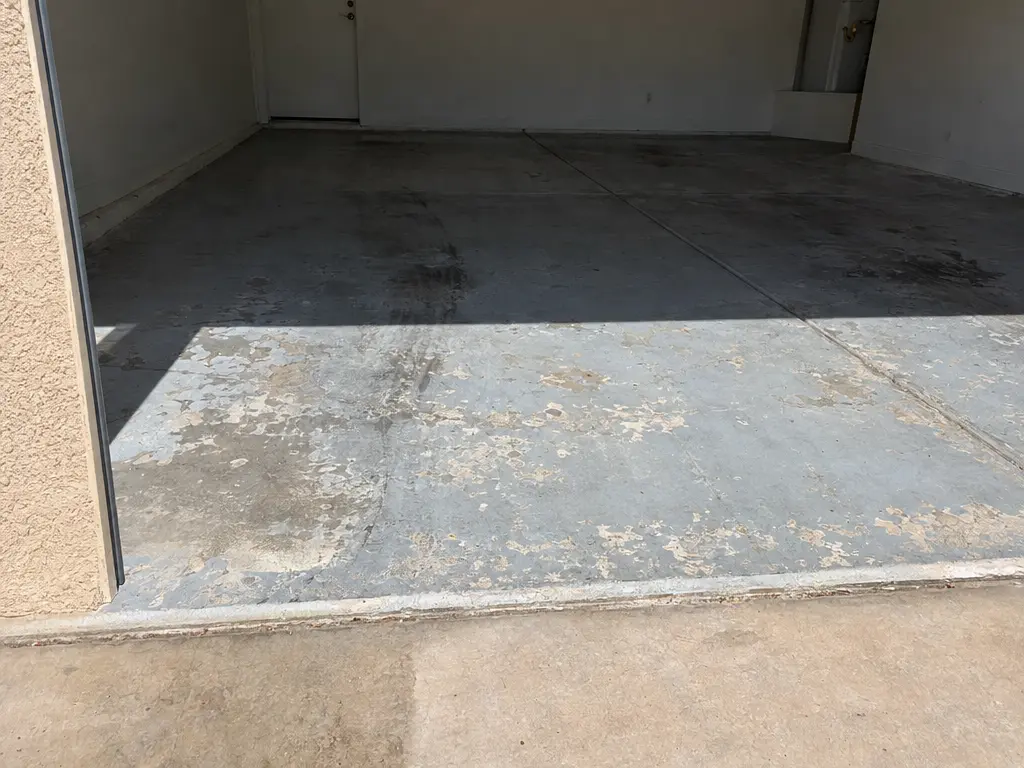
Most garage floor coatings that fail in Spring Valley do not fail because epoxy is a bad material. They fail because the heat finds every shortcut taken during the install. Here is what goes wrong, and what holds up.
What the valley's heat does to a garage floor
Start with the numbers. Over the 1991-2020 normals, Las Vegas averaged 78 days a year at 100F or hotter at the official airport station. The July normal high is about 104.5F. On July 7, 2024 the National Weather Service recorded 120F, the hottest reading on record here, and 2024 finished with more than 100 days at 100F or above.
A garage sits in the middle of that. The slab heats through the day, the door goes up and down, and a car that just crossed Spring Mountain Road or the 215 rolls in with hot tires. Every coating on the market can handle warm. Far fewer handle warm plus weak prep plus a thin film.
That combination is where most failures start.
Hot-tire pickup: the failure you see first
This is the one people call about. A patch of coating comes up in the shape of a tire tread, usually right where the car parks.
Here is the mechanism. Hot tires soften the surface they sit on. As the tire and the floor cool, the rubber grips the coating, and when the car backs out, it pulls. If the bond to the concrete is weak, the coating goes with it. Chemicals in the tire rubber can make it worse.
Three things raise the risk sharply. A film that is too thin. A slab that was never ground to a proper profile. And parking on the floor before the coating has cured. Fix those and the problem mostly goes away.
Sun through the open door: UV and ambering
Standard epoxy is an aromatic resin. Under ultraviolet light it slowly yellows and can chalk, and summer UV in Las Vegas reaches the extreme range on the EPA scale. A garage facing west with the door up through a summer afternoon gets a steady dose across the front few feet of floor.
The result is a floor that looks two-tone after a few years: amber near the door, the original color in the back.
The cure is chemistry, not more coats. Aliphatic resins, such as polyaspartic and aliphatic urethane, do not amber the same way. Put one on as the top layer and the color holds far better.
One honest caveat. A clear aliphatic topcoat over epoxy slows the yellowing underneath, but sunlight still passes through, so it does not stop it completely. Lighter flake blends hide what change there is.
Installing in the heat: why cure timing matters
Coatings cure by chemical reaction, and heat speeds the reaction up. Working time and cure time both get shorter as the temperature climbs. That sounds like good news. On a hot day it is a hazard.
Fast-setting material mixed in a big batch can start to thicken, skin over or heat up in the bucket before it is spread. Polyaspartic already has a short pot life, often under half an hour on product data sheets, and heat cuts into that. Careful crews mix smaller batches and move with a plan.
The slab matters too. A slab that is warming during application pushes air out through the wet film, which leaves bubbles and pinholes. Coating while the slab temperature is steady or falling avoids most of it. That is one reason summer installs often start early in the day.
The part nobody sees: slab moisture and prep
Most of the failures above trace back to prep. A coating needs a rough, clean mechanical profile to grab. Diamond grinding gives it that. Acid etching, the old DIY-kit method, does not get rough enough for a thick modern system and soaks the slab with water besides. Some major coating makers have stopped recommending it.
Then there is moisture. It sounds odd in the driest major metro in the continental US, but water vapor still moves up through a slab on grade, and it can lift a coating from below.
That is why a slab gets tested before coating. A calcium chloride dome measures what leaves the surface, and an in-slab probe reads deeper. When a test comes back high, the answer is a moisture-blocking primer or more drying time, not hope.
Cracks get attention here too. Static cracks are routed out and filled before the base coat. Joints that move are left to move, because a rigid coating bridged across them will simply crack again.
What to pick instead
For most garages in the Las Vegas valley, the system that holds up looks like this: a ground and tested slab, a 100%-solids epoxy base for thickness and bond, a full flake broadcast, and a polyaspartic topcoat as the wear and UV layer.
The flake adds texture and hides small pits and hairline cracks. The polyaspartic top resists sun and scuffs.
Why not a big-box kit? Most of those are water-based epoxy. A wet coat goes down thick, but much of it is water that leaves as it dries, so the film that remains is thin. Thin films are exactly what hot tires pull up.
Some owners want a full polyaspartic or polyurea system instead of an epoxy base, mostly for faster return to service.
A polyaspartic coat can cure as fast as two hours under the right conditions, and light foot traffic often follows within hours. Full chemical cure takes longer, commonly about a week, and that is the date that matters before parking a hot car on it.
Whichever way you go, ask any installer three questions. How will you prep the slab? Will you test it for moisture? What goes on as the top coat? The answers tell you more than the color chart does.
If your garage needs a floor that can live with all of this, see how we approach garage floor epoxy in Spring Valley.